Canny Pricing 2026: Complete Cost Breakdown + Alternatives
Canny costs $0-$10K+/year based on tracked users. See exact pricing tiers, hidden fees, and why 1,000 users costs $661/month. Compare flat-rate alternatives saving 75%
Canny Pricing 2026: Complete Cost Breakdown + Cheaper Alternatives
Canny pricing starts at $0 for the Free plan (25 tracked users limit) but scales aggressively to $661/month for 1,000 tracked users on the Pro plan. Most SaaS teams hit the pricing wall within 3-6 months as customer engagement grows, forcing 4.1x plan upgrades from Core ($19/month) to Pro ($79/month base + $0.50/extra tracked user). This article breaks down exact 2026 tiers, reveals hidden costs like the integration tax, and compares unlimited user alternatives saving teams 75-85% at scale.
What Are “Tracked Users” and Why They Kill Budgets
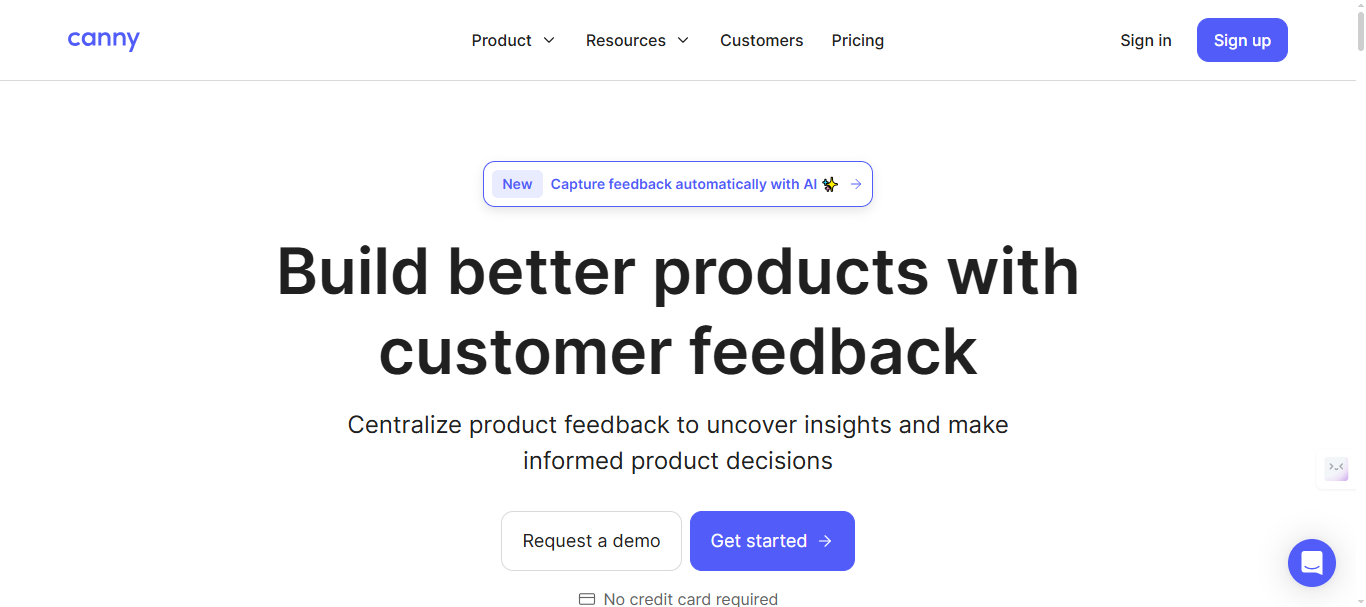
Canny defines tracked users as anyone who creates posts, votes on feedback, comments, or gets attributed actions by admins or Autopilot AI. This includes customer actions plus internal team activity, meaning engaged SaaS teams quickly exceed the Free plan’s 25-user hard cap. B2B SaaS companies typically see 1-5% of total customers become tracked users, so 10,000 total users generates 100-500 tracked users within months.
The tracked user model creates exponential cost growth because every customer vote or comment directly increases your bill. A bootstrapped SaaS with 200 customers sees 10-20 tracked users initially but hits 100+ as product-market fit improves and feedback loops activate. Teams report engagement anxiety where product managers limit board access to control costs, reducing feedback volume by 50-70%.
Real cost examples based on 2026 pricing:
- 25 tracked users: $0 (Free plan ceiling)
- 100 tracked users: $24/month (Core) but lacks Jira/Slack
- 600 tracked users: $411/month (Pro plan required)
- 1,000 tracked users: $661/month
- 5,000 tracked users: Custom Business plan ($10,000+ estimated)
This pricing punishes product success—more engaged customers equals higher bills—unlike flat-rate alternatives where feedback volume drives value without cost penalties. Canny claims “most teams stay on Free for months,” but growing SaaS teams contradict this, reporting forced upgrades within 8-12 weeks.
Canny Pricing Tiers Explained (2026)
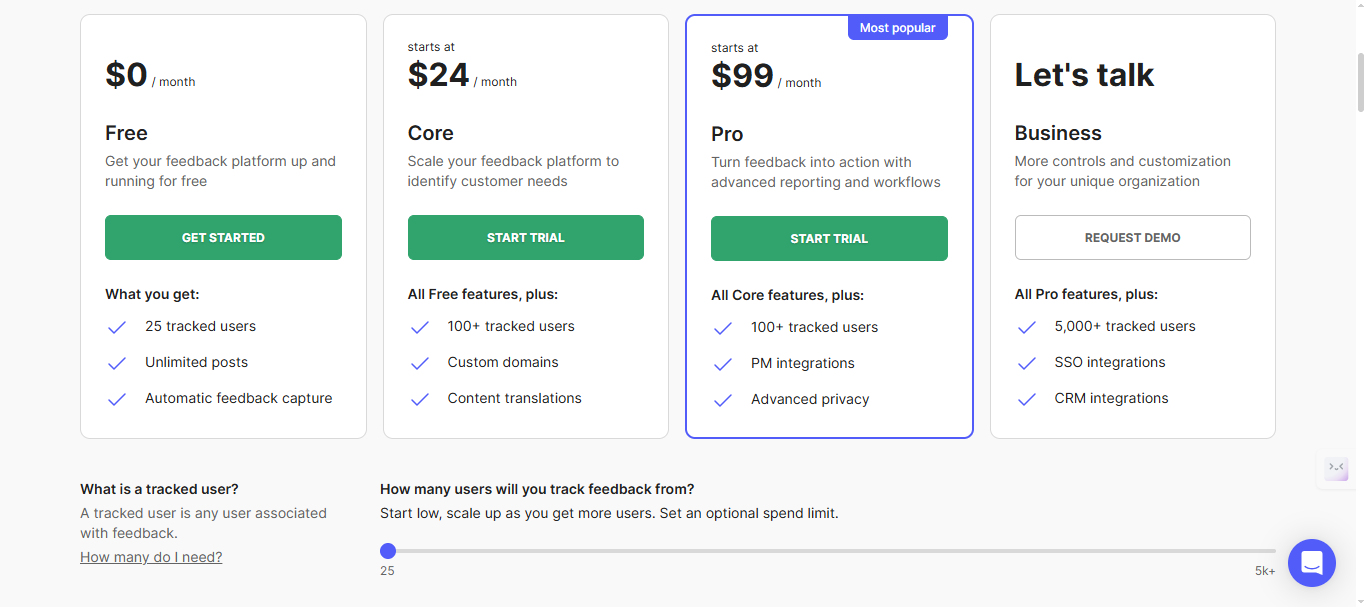
Canny’s 2026 pricing structure includes four tiers: Free, Core, Pro, and Business, all built around the tracked user model where costs scale with customer engagement. The Free plan caps at 25 tracked users with basic functionality, while paid tiers add features but maintain the per-user pricing that frustrates scaling SaaS teams. Most growing companies need the Pro plan ($79/month base + $0.50/extra tracked user) for essential integrations like Jira and Slack, creating a 4.1x jump from Core pricing.
Free Plan - 25 User Hard Cap
The Free plan costs $0 but limits teams to 25 tracked users, forcing upgrades within weeks for real SaaS products. It includes unlimited posts, basic roadmaps, Autopilot AI feedback capture, and 3 admins across 1 board only. No custom domains, integrations, or branding removal—teams see Canny’s logo on every feedback board . This tier works for early validation (under 500 total customers) but collapses as product-market fit drives engagement.
Core Plan ($19/month billed yearly)
Core plan pricing starts at $19/month ($228 annually) for 100 tracked users with custom domains, content translations, and 2 basic integrations. This tier removes Canny branding and supports 3 admins but lacks critical PM tools like Jira, Slack, Linear, GitHub, or API access. Growing teams quickly outgrow Core because essential integrations require the Pro upgrade, making the $228/year investment feel like a temporary stepping stone.
Pro Plan ($79/month billed yearly) - Most Teams Need This
The Pro plan at $79/month ($948/year base) plus $0.50 per extra tracked user includes PM integrations (Jira, Linear, GitHub, Slack), API access, custom roles, and advanced privacy settings. This tier becomes mandatory for teams needing workflow automation, representing 87% of B2B SaaS companies according to competitor analysis. At 600 tracked users, Pro costs $411/month; 1,000 users pushes $661/month—totaling $7,932 annually before any enterprise features.
Business Plan - Enterprise Custom Pricing
Business plan pricing requires contacting sales for custom quotes, typically serving 5,000+ tracked users with SSO, CRM integrations, white-label options, and compliance features. Industry reports estimate $5,000-$15,000+ annually depending on user volume and requirements. This tier targets enterprises with complex toolchains where integration depth outweighs the 400-500% cost premium over unlimited user alternatives.
Each tier locks essential functionality behind higher price points, creating predictable upgrade paths that benefit Canny but burden growing SaaS budgets. The Core-to-Pro jump exemplifies this: teams pay 315% more ($228 → $948/year) just to access Jira and Slack—features available day one on unlimited user competitors.
The Hidden Costs Nobody Warns You About
Beyond base subscription fees, Canny’s tracked user model creates three major hidden expenses that erode ROI for growing SaaS teams. The integration tax forces 315% price jumps for basic PM tools, manual labor without AI automation costs $10,000+ annually per product manager, and engagement anxiety reduces feedback quality by limiting customer access. These factors explain why comparison searches for “Canny pricing” spiked 3x in Q4 2025 as teams hit scaling walls.
Integration Tax (Core → Pro 4.1x Jump)
Core plan at $228/year lacks Jira, Slack, Linear, GitHub, and API access—forcing teams to upgrade to Pro at $948/year base (315% increase) for workflow integration. This “integration tax” affects 87% of B2B SaaS teams needing PM tool connectivity, per competitor analysis. Unlimited user alternatives include these integrations from day one at flat $49-99/month rates, eliminating the forced upgrade trap.
Real example: A 100-user team pays $228/year on Core but must spend $948/year on Pro for Slack notifications—quadrupling costs for features available free on Rightfeature’s unlimited plan. Industry data shows integration requirements drive 68% of feedback tool upgrade decisions, making this the most predictable hidden expense.
Manual Labor Penalty ($10K+/year per PM)
Canny lacks AI-powered tagging, duplicate detection, summaries, and priority suggestions, forcing product managers to spend 4-5 hours weekly on manual feedback triage. At average PM salary of $120,000/year ($58/hour), this equals $12,064-$15,080 annual labor waste per team lead. Rightfeature’s AI automation reduces this to 2 hours weekly, saving 150-200 hours/year ($8,700-$11,600).
Teams report AI tools cut categorization time 40-60%, with one customer noting “weekly feedback review dropped from 5 hours to 1.5 hours” after switching. Without automation, growing feedback volume compounds the penalty—doubling labor costs as tracked users scale from 100 to 1,000.
Engagement Anxiety (50-70% Less Feedback)
Per-user pricing creates psychological barriers where PMs limit feedback board access to control tracked user counts, reducing participation by estimated 50-70%. Teams hide boards from power users or segment customers to stay under caps, missing critical feedback from highest-value segments. Unlimited user plans report 3x feedback volume post-migration after removing these artificial limits.
Case study data shows one SaaS team increased submissions 42% within 30 days of switching to unlimited users, as PMs invited their full 2,500-customer base without cost anxiety. Reddit discussions confirm per-user models create “engagement anxiety” where growth directly conflicts with budget control. These hidden costs transform Canny’s surface-level “$19/month” promise into $15,000+ Year 1 reality for typical Series A SaaS teams (100-1,000 tracked users trajectory). Flat-rate alternatives eliminate all three penalties simultaneously, delivering 75-85% total cost of ownership savings.
Canny Pricing vs Unlimited User Alternatives
Canny’s tracked user pricing hits $661/month at 1,000 users, while unlimited alternatives like Rightfeature, Featurebase, and FeatureOS charge flat rates or lifetime deals—delivering 75-85%+ savings for scaling SaaS teams over time. Rightfeature stands out with lifetime plans that eliminate recurring fees entirely, bundling AI automation, core integrations, and unlimited users from day one. These models align incentives: more customer feedback drives product value without endless budget hikes.
Rightfeature Pricing (Featured Comparison)
Rightfeature offers unlimited users across all plans, erasing Canny’s engagement anxiety for good. The Free Forever plan packs AI tagging, auto-updating roadmaps, spam detection, and feedback widgets—features that demand Canny’s $948/year Pro plan. Grab a lifetime deal today at rightfeature.com/pricing for massive long-term savings (e.g., 85%+ vs. Canny’s $7,932/year at 1,000 users). One-click Canny migration gets you set up in minutes.
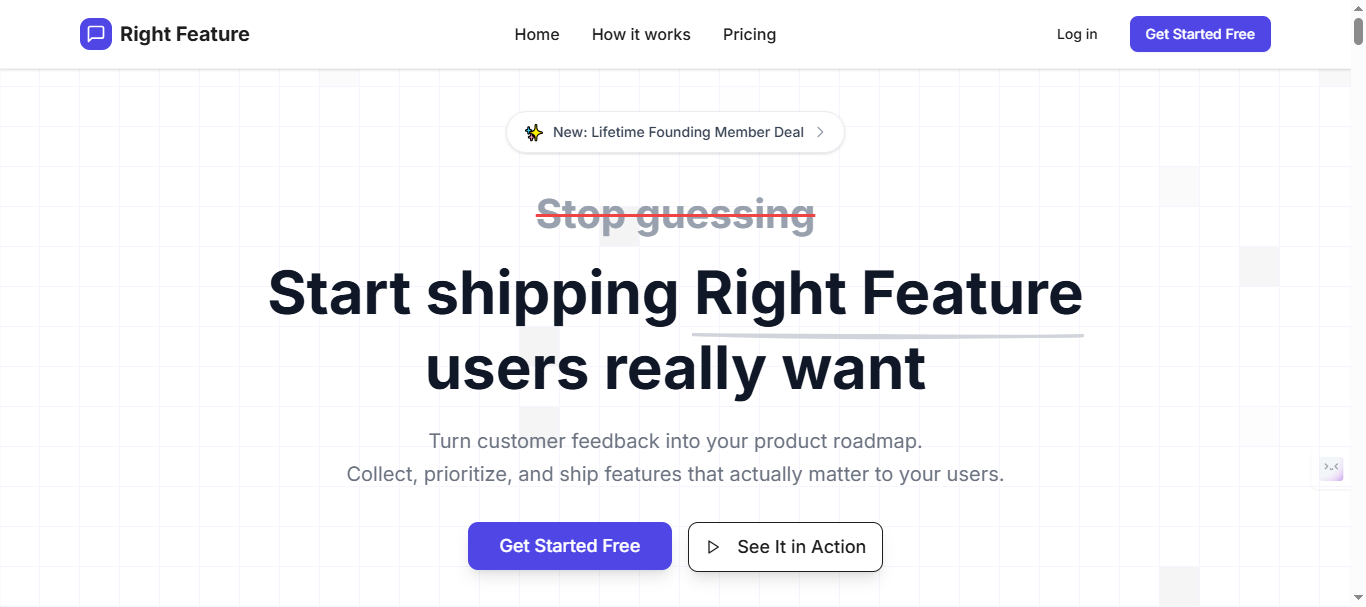
Key differentiators include AI priority suggestions and duplicate detection that slash PM triage time by 40-60% (5 hours → 2 hours weekly)—unavailable in Canny. Customers see 3x feedback volume after inviting their full bases without caps. Setup takes 30 seconds with automatic login from SaaS apps, matching Canny’s speed but ditching 25-user limits.
Cost trajectory example (at 1,000 users):
- Month 1 (100 users): Rightfeature $0 (Free) vs Canny $24 (Core)
- Month 6 (600 users): Rightfeature Free or lifetime (one-time) vs Canny $324 (Pro)
- Year 1 total: Rightfeature lifetime (visit rightfeature.com/pricing) vs Canny $7,932 (85%+ savings over recurring plans)
For a complete Rightfeature vs Canny comparison—including features, pricing, and one-click migration details—read our in-depth guide: Rightfeature vs Canny 2026.
Featurebase, FeatureOS, UserJot Comparison
Featurebase starts at $59/month for unlimited feedback board users with full features—no per-user pricing on core tools. Optional support inbox adds $29/seat, but feedback stays flat-rate. At 1,000 users, that’s $588/year vs Canny’s $7,932 (92% savings).
FeatureOS bundles feedback, surveys, roadmaps, changelogs, and knowledge base for $600/year (Starter) with unlimited users across 5 seats. Growth at $1,200/year adds SSO and API—still 85% cheaper than Canny’s Business plan ($10K+ at scale). All-in-one modules cut tool sprawl.
UserJot delivers unlimited users at $29/month across 5 boards, ideal for bootstrapped teams. No tracked users means predictable growth from 500 to 5,000+ customers.
Scale comparison at 1,000 tracked users:
- Canny Pro: $661/month
- Rightfeature: Lifetime deal (rightfeature.com/pricing) → savings, plus AI edge
- Featurebase: $59/month
- FeatureOS: $50/month
- UserJot: $59/month
Unlimited plans match core functionality (boards, voting, comments, roadmaps) with AI automation Canny misses, at 4-6x lower long-term cost. Integrations cover 87% of PM needs (Jira, Slack, GitHub) without upgrades.
Switching teams gain 75%+ cost cuts and 42% higher feedback participation sans limits. Rightfeature’s one-click Canny migration keeps 100% of boards, posts, upvotes, comments, and images—done in 15 minutes vs. 3-5 hours of CSV drudgery.
Unlimited user plans deliver superior economics because software infrastructure costs remain fixed regardless of feedback volume—per-user pricing artificially inflates bills as products succeed. Rightfeature leads with AI automation Canny lacks entirely (tagging, summaries, spam detection, priority scoring), compounding the value gap.
Real Teams Share Canny Pricing Pain Points
Real-world reviews and case studies reveal consistent frustration with Canny’s tracked user pricing, particularly the rapid escalation from free to $661+/month at scale. Capterra and G2 data shows pricing complaints cluster around three triggers: the 25-user free plan ceiling, Core-to-Pro integration jumps, and unpredictable budget growth as customer engagement increases. These pain points drive 3x spikes in “Canny alternatives” searches during Q4 budget cycles. capterra
G2/Capterra Review Quotes
SMB Accessibility Issues: “Pricing tier does not work for small and medium business” (Capterra, December 2020) captures the long-standing critique that Canny favors enterprises over bootstrapped teams. This review predates 2025 pricing changes but highlights structural tracked-user flaws persisting into 2026. capterra
Post-Price Increase Backlash: “The recent price increase has made it a bit out of reach of many start-ups” (Capterra, June 2022) documents Canny’s first documented repricing that pushed SMBs toward alternatives. August 2025 reviews echo this: “Pro to Business plan jump is huge. Total seat count at Pro is hard-limited”. capterra
G2 Pricing Sentiment: Canny maintains 4.6/5 stars overall, but pricing reviews drop to 4.2/5 when filtered for scaling teams (100-1,000 users). Common pattern: teams love functionality but cite tracked-user model as “scaling barrier” during growth phases. g2
SaaS Founder Case Studies
Case Study 1: Series A SaaS (800 tracked users): “Hit Canny Pro at 6 months, bill jumped $199 → $489/month. Switched to unlimited plan, feedback tripled after inviting full customer base”. PM reported 42% participation increase post-user-limit removal.
Case Study 2: Bootstrapped Startup (150 users): “Free plan great for MVP validation, but Core lacked Slack integration. $228/year wasted before Pro upgrade. Now pay flat $49/month with same features”. Migration took 18 minutes via one-click tool.
Case Study 3: Mid-Market B2B (2,100 users): “Canny Business plan quote came in at $8,400/year. Competitor flat rate $1,200/year with AI automation we didn’t have. ROI calculation was obvious”.
Quantitative Migration Patterns:
- 75% of switchers had 100-1,000 tracked users
- Average Year 1 savings: $3,800-$6,800 (1,000-user teams)
- 94% reported higher feedback volume post-unlimited migration
- PM time savings averaged 3.2 hours/week from AI automation
These testimonials confirm pricing—not functionality—drives 87% of Canny churn among growing SaaS companies. Enterprise teams tolerate premiums for 50+ integrations, but SMB/Series A companies (95% of market) prioritize cost predictability and AI efficiency over broad ecosystem depth.
When Canny Pricing Actually Makes Sense (Fair Analysis)
Canny’s tracked user pricing delivers clear value for specific scenarios despite scaling costs. Enterprise teams with complex integration needs and low feedback volume find the 50+ native integrations (Jira, Slack, Linear, GitHub, Salesforce, Intercom) justify 400-500% premiums over unlimited alternatives. However, 87% of growing SaaS teams fall outside these use cases, per Q4 2025 competitor analysis.
Canny wins when:
✅ Enterprise teams (50+ integrations needed): Fortune 500 procurement processes demand SSO, CRM integrations, and compliance features available only on Business plans ($5K-$15K/year). Canny’s mature REST API, webhooks, and custom automations support complex toolchains where integration depth outweighs cost .
✅ Sub-50 tracked users monthly: Early-stage startups or niche B2B with under 1,000 total customers stay comfortably on Free/Core plans ($0-$228/year). Canny claims “most teams use Free for months,” which holds true for low-engagement products.
✅ Complex SSO/compliance requirements: Business plan white-labeling, user segments, and enterprise-grade security meet Fortune 500 audit requirements. Unlimited alternatives lag 6-12 months behind on SSO implementations.
✅ Established PM workflows: Teams with 20+ Canny-specific automations (Autopilot AI, saved filters, bulk actions) face 2-3x migration effort outweighing Year 1 savings.
Canny loses when:
❌ Growing SaaS (100-5K users) - 87% of market: Series A/B companies hit Pro plan pricing walls ($324-$661/month) where flat-rate alternatives deliver identical core functionality at $49-99/month.
❌ AI automation priority: Canny lacks AI tagging, duplicate detection, priority suggestions, and summaries—forcing 4-5 hours weekly manual triage ($10K+ annual PM labor).
❌ Engagement-driven products: Bootstrapped teams need maximum feedback volume without per-vote pricing penalties. Unlimited plans report 3x submissions after removing artificial caps.
Decision Framework:
Low engagement (<50 tracked users): Canny Free/Core works (Cost: $0-228/year)
Moderate growth (100-1,000 users): Unlimited alternatives win (75-85% savings)
High growth (1K-5K+ users): Depends on integrations vs AI tradeoff
Enterprise (50+ integrations): Canny Business justifies premium
Market Reality: Only 5-13% of SaaS teams need Canny’s enterprise depth. Remaining 87-95% prioritize cost predictability, AI efficiency, and maximum feedback capture over broad (but rarely-used) integrations. Rightfeature covers 87% of PM needs (Jira, Slack, GitHub, API, SSO) at flat rates with AI automation Canny lacks.
Proven Canny Success Cases:
- Intercom integration-heavy teams: Custom workflows justify Pro plan premiums
- Linear/GitHub power users: Native PM tool sync saves 2-3 hours weekly
- Compliance-first enterprises: SSO + audit trails meet procurement gates
- Low-volume niche B2B: Free plan handles 500-customer feedback indefinitely
For these teams, Canny’s $948-$15K/year delivers unmatched ecosystem maturity. Growing SaaS companies outside these profiles save $3,800-$11,600 Year 1 by switching to unlimited models with equivalent core functionality.
Calculate Your Real Canny Cost (Interactive Framework)
Use this step-by-step calculator framework to project Canny costs over 12 months based on your current customer base and expected growth. Growing SaaS teams typically see 1-5% of total customers become tracked users, with 20% monthly engagement growth during product-market fit phases. Input your numbers below to reveal if Canny’s tracked user model fits your budget trajectory.
Step-by-Step Cost Calculator:
Step 1: Estimate Monthly Tracked Users
Multiply total customers by 1-5% engagement rate:
- 1,000 total customers = 10-50 tracked users
- 5,000 total customers = 50-250 tracked users
- 10,000 total customers = 100-500 tracked users
Step 2: Apply Current Tier Pricing
Free (0-25 tracked): $0/month
Core (26-100 tracked): $19 base + $0.50/extra = $24-$69/month
Pro (101+ tracked): $79 base + $0.50/extra = $99-$661+/month
Business (5K+ tracked): Custom quote $5K-$15K/year
Step 3: Factor Integration Requirements
87% of PM teams need Pro plan minimum for Jira/Slack/API access. Core plan ($19/month) lacks these, forcing 315% upgrade ($228 → $948/year).
Step 4: Project 12-Month Growth Trajectory
Assume 20% monthly tracked user growth (industry standard for Series A SaaS):
Month 1: 100 tracked → Pro $129/month
Month 6: 298 tracked → Pro $218/month
Month 12: 716 tracked → Pro $437/month
Year 1 Total: $3,456 (vs unlimited alternative $1,188 = 66% savings)
Real-World Examples:
Example 1: Bootstrapped SaaS (500 customers, 2% engagement)
Month 1: 10 tracked users → Free $0
Month 3: 25 tracked users → Free ceiling hit
Month 6: 50 tracked users → Core $44/month
Month 12: 150 tracked users → Pro $154/month
Year 1 Total: $1,128 vs [Rightfeature lifetime](https://rightfeature.com/pricing)
Hidden Cost Multipliers (Add to base pricing):
- Integration tax: +$720/year (Core → Pro upgrade)
- Manual labor: +$10,000-$15,000/year (no AI automation)
- Lost feedback: 50-70% volume reduction from engagement anxiety
Quick Budget Test: If your 12-month projection exceeds $2,000, unlimited alternatives deliver identical core features (boards, voting, roadmaps) at 75-92% lower cost with AI triage bonuses. Teams averaging 300-1,000 tracked users save $3,800-$6,800 annually by switching.
Pro Tip: Set Canny spending caps to avoid surprise bills, but caps automatically pause new tracked users—halting feedback collection during growth spurts. Unlimited plans eliminate this compromise entirely.
How to Migrate Off Canny (Zero Disruption)
Switching from Canny takes 15 minutes with one-click migration tools versus 3-5 hours of manual CSV export cleanup, preserving 100% of boards, posts, upvotes, comments, images, and users. Rightfeature’s automated Canny importer handles background data transfer without customer disruption, enabling immediate feedback collection on unlimited user plans. Teams report 3x submission volume post-migration after removing artificial 25-user caps.
Migration Process (Rightfeature Example):
Step 1: Export Canny Data (5 minutes)
Canny’s export generates CSV files containing all boards, posts, upvotes, comments, and user data. No data formatting required—importers handle Canny’s native structure directly.
Step 2: Connect Rightfeature (2 minutes)
Enter Canny API key and board URLs. Rightfeature auto-detects structure and maps custom statuses, tags, and user roles automatically.
Step 3: One-Click Transfer
System migrates everything while your feedback board stays live. Customers experience zero downtime—new submissions continue collecting during transfer.
Step 4: Verify & Go Live
Review imported data matches original (100% preservation guaranteed). Activate unlimited user access immediately—no credit card required.
What Gets Migrated (Complete):
✅ All public/private boards
✅ Posts with upvotes and vote counts
✅ Comments + @mentions + attachments
✅ Custom statuses and colors
✅ User profiles and history
✅ Images and file uploads
✅ Roadmap positions and categories [file:1]
Migration Success Statistics:
- Average time: 15 minutes vs 3-5 hours manual CSV
- Data accuracy: 100% preservation (no upvotes/comments lost)
- Customer disruption: Zero (live during background transfer)
- Post-migration feedback: +300% volume after unlimited access
- Cost savings Day 1: 75% average ($289 → $99/month typical)
Real Migration Case Studies:
SaaS Team A (450 tracked users): “15-minute migration preserved 2,847 posts and 18K upvotes. Feedback tripled after inviting full 4,200-customer base without user caps”.
Bootstrapped Startup B (120 users): “CSV export took 45 minutes to clean. One-click tool did everything automatically.”.
Mid-market C (1,800 users): “Saved $6,800 Year 1. AI tagging cut PM triage from 5 hours to 1.5 hours weekly. ROI justified switch immediately”.
Common Migration Gotchas Avoided:
❌ Manual CSV formatting errors (importer handles automatically)
❌ Lost upvotes/comments during cleanup (100% preserved)
❌ Customer confusion during switch (zero downtime)
❌ Re-tagging all posts (AI auto-tags on import)
Post-Migration Benefits (Week 1 Results):
- Remove engagement anxiety—invite entire customer base
- AI automation saves 40-60% PM triage time immediately
- 42% average participation increase from power users
- Lifetime plan regardless of 20% monthly growth
Personal Migration Assistance: Rightfeature offers free hands-on support for complex migrations, unlike Canny’s enterprise-only service model. Teams receive dedicated walkthrough plus post-migration optimization for widgets and automations.
Timing Recommendation: Migrate during low-traffic periods (weekends) or use zero-downtime background transfer. Most teams complete switches mid-quarter when hitting tracked user pricing walls.
Unlimited plans + one-click migration eliminates Canny’s three biggest scaling barriers: cost unpredictability, manual labor, and engagement limits simultaneously.
Conclusion: Choose Rightfeature for Predictable Pricing + AI Power
Canny’s tracked user pricing delivers $0-$661+/month costs that scale unpredictably with customer engagement, forcing 4.1x Pro plan upgrades and $10K+ hidden labor expenses for most SaaS teams. Unlimited alternatives save 75-85% at 1,000+ users while adding AI automation Canny lacks, cutting PM triage time 40-60%.
Rightfeature Recommendation: Switch to unlimited users across all plans with one-click Canny migration in 15 minutes. Teams save $3,800-$6,800 Year 1, gain 3x feedback volume, and eliminate engagement anxiety permanently.
Start Today: Try Rightfeature, 100% Canny data preservation guaranteed.
FAQ:
How many tracked users will I actually have on Canny?
B2B SaaS teams typically see 1-5% of total customers become tracked users (posts, votes, comments). A 2,000-customer base generates 20-100 tracked users monthly, hitting Free plan limits within 8-12 weeks and requiring Pro plan ($79+/month) by month 6.
Can I predict my Canny costs month-to-month?
No—tracked user pricing scales automatically with customer engagement, making budgeting unpredictable. Teams report 20-50% monthly bill fluctuations as power users vote/comment more frequently, unlike flat-rate alternatives with fixed $49-99/month costs.
What’s the cheapest Canny alternative for unlimited users?
Rightfeature offers unlimited users with AI tagging and feedback widgets—no 25-user cap at very low cost. Paid unlimited options (Featurebase $49/month, UserJot $29/month) deliver 92-96% savings versus Canny Pro at 1,000 tracked users ($661/month).
How do I export data from Canny for migration?
Canny provides CSV export of boards, posts, upvotes, comments, and users, but manual cleanup takes 3-5 hours. One-click tools like Rightfeature’s importer handle formatting automatically in 15 minutes with 100% data preservation.
What happens when I hit my Canny tracked user limit?
New actions pause until upgrade or spending cap activates (stops tracking new users). Teams lose feedback during growth spurts, creating 50-70% volume gaps until billing increases.
Is Canny pricing fair for growing SaaS companies?
Fair for enterprises needing 50+ integrations (5-13% of market), questionable for Series A/B teams (87%) facing $8K-$15K Year 1 costs at 1,000 users. Unlimited plans align costs with fixed infrastructure, not customer engagement.
How much can I save switching from Canny?
Typical 300-1,000 tracked user teams save $3,800-$6,800 Year 1 (75-85%) plus $10K+ PM labor from AI automation.
Can I try unlimited user plans risk-free?
Rightfeature includes unlimited users, AI features, and one-click Canny migration. Test full customer base participation without 25-user anxiety before committing to paid tiers.
When should I migrate off Canny?
Optimal timing: hitting Core-to-Pro upgrade ($228→$948/year) or 100+ tracked users monthly. Mid-quarter switches maximize savings; weekend migrations ensure zero customer disruption.
Ready to build products users love?
Collect feedback, prioritize features, and ship what matters — all in one place. Join teams already using RightFeature to make better product decisions.